

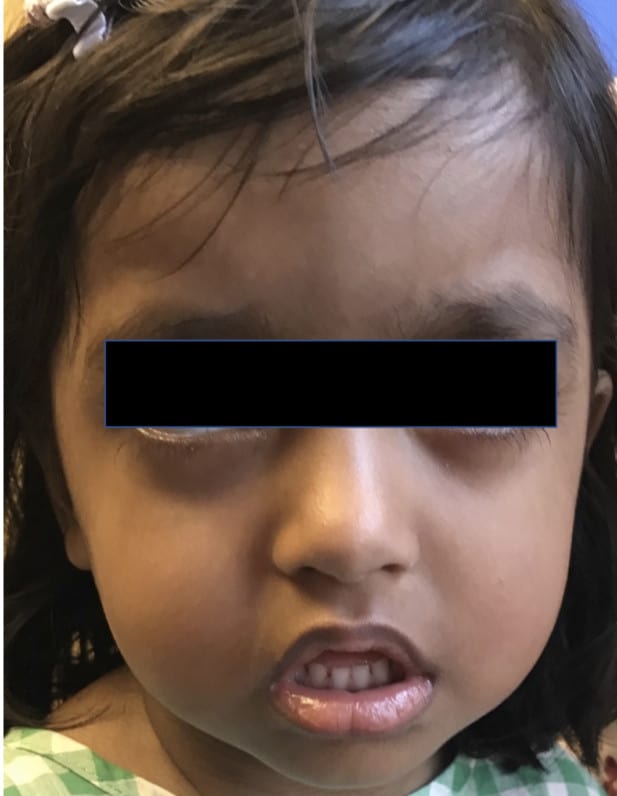
For many children with snoring, allergic rhinitis is a contributor to this condition. In addition, big tonsils and adenoids are also frequently associated with this. For some kids, they can be chronic mouth breathers. This can result in adenoid facies (long face syndrome) and they can grow up with occlusal/ dental issues. (See image shown in a child who is a mouth breather and dental issues. In addition, there are dark eye circles which are indicative of strong allergies. These are known as allergic eye shiners) Find out more about snoring child here https://www.sleepfoundation.org/articles/snoring-children.
Treatment will include allergic rhinitis. On top of the nasal sprays, it is important to do a skin prick test to test for allergies. Allergen avoidance will be important. It is also important to assess the size of tonsil and adenoids as these are important prognostic factors for improvement of the snoring with nasal sprays. Generally speaking most patients with Grade 1 and 2 tonsil and adenoids do well with allergen avoidance and medications. Grade 3 and 4 tonsil and adenoids may not respond as well. Some patients may need a tonsillectomy and adenoidectomy to treat their condition. Thankfully most patients respond well with medications and may not need operation.
A sleep study to assess potential sleep apnea in children is necessary if they are morbidly obese or associated with other medical problems. If your child is facing issues with snoring, consider visiting Dr. Dennis Chua.
References
- https://pubmed.ncbi.nlm.nih.gov/26333074/
Chawla, J., & Waters, K. A. (2015). Snoring in children. Journal of paediatrics and child health, 51(9), 847–851. https://doi.org/10.1111/jpc.12976 - https://pubmed.ncbi.nlm.nih.gov/23606206/
Manuel, A., Witmans, M., & El-Hakim, H. (2013). Children with a history of prematurity presenting with snoring and sleep-disordered breathing: a cross-sectional study. The Laryngoscope, 123(8), 2030–2034. https://doi.org/10.1002/lary.23999






 ENT Surgeons Medical Centre